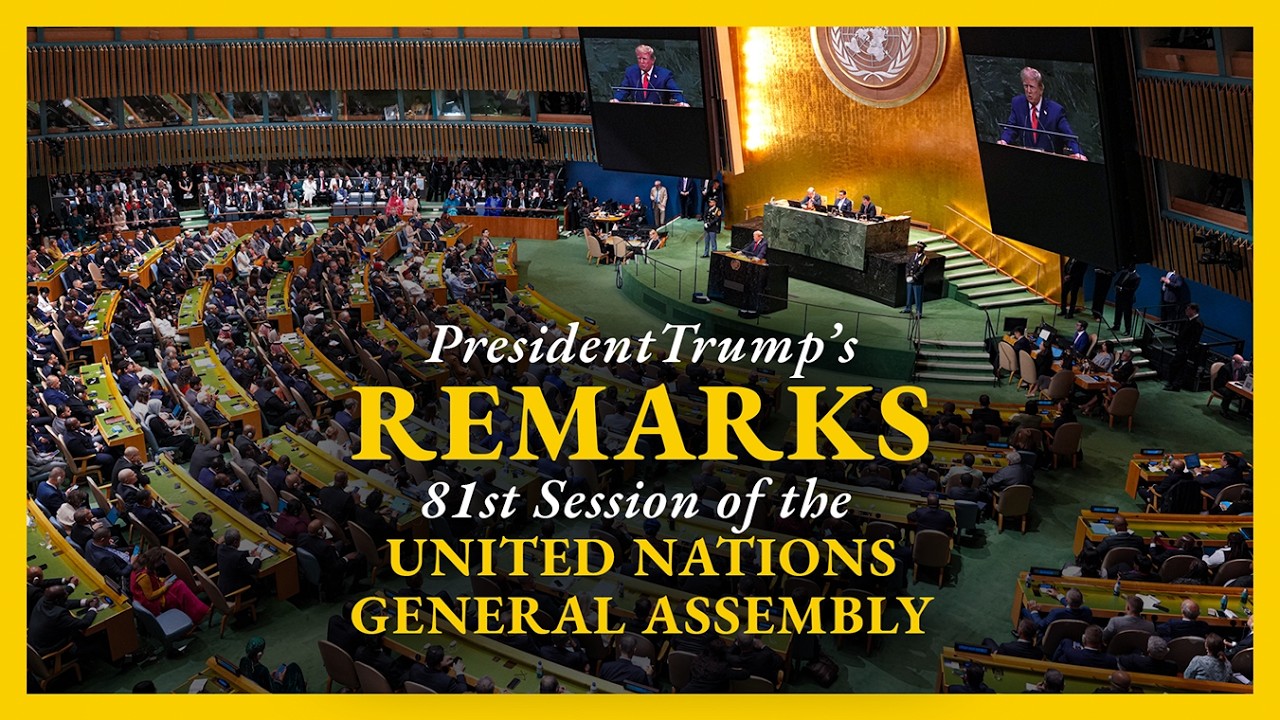
Thirty-two minutes into his address to the United Nations General Assembly this morning, President Donald Trump paused, looked up from his prepared remarks, and retired a word. 'The use of the word artificial makes intelligence sound fake,' he told the assembled delegates. 'It makes it sound fake and it is not fake. It's actually amazing.' From that moment, at least as far as the United States government is concerned, artificial intelligence ceased to exist. In its place: SuperIntelligence. SI.
'The United States also totally rejects any attempt to construct a globalist scheme to control for the artificial intelligence being spoken of so much now here and after — officially called super intelligence — changing the name, and that the use of the word artificial makes intelligence fake. It makes it sound fake and it is not fake. It's actually amazing.' — President Trump, UN General Assembly, September 22, 2026
The Word He Used
The declaration came in what the White House had billed as Chapter 8 of the speech — a section devoted entirely to what Trump called 'the new world of super intelligence.' His argument was simple, direct, and delivered with the cadence of someone who had been thinking about it for a while: the prefix 'artificial' undermines the thing it describes. It implies simulation. It implies imitation. It implies something less than real.
'The United States also totally rejects any attempt to construct a globalist scheme to control for the artificial intelligence being spoken of so much now here and after — officially called super intelligence — changing the name, and that the use of the word artificial makes intelligence fake. It makes it sound fake and it is not fake. It's actually amazing. We have to be careful. In fact, it is exactly the opposite of what it purports. From this point forward, all of United States documents and hopefully the world's will be changed to use the much more accurate term: super. As opposed to artificial. So it's super intelligence. In other words, welcome to the new world of super intelligence — SI.'
He then paused, smiled, and added: 'Let's see if that goes. It sounds much better. It is much better. And it's much more accurate. Let's see if I have any power. Maybe I do and maybe I don't. We're going to find out pretty soon.'
A Rejection of Globalist Control
The renaming did not arrive in isolation. By coupling the new terminology with a rejection of international governance frameworks, Trump was doing two things at once: asserting American ownership of the technology's identity, and pre-emptively blocking any multilateral body from claiming authority over it. The United Nations, the venue for the speech, was being told — politely, but unmistakably — that it would not be setting the rules for what happens next.
Several delegations in the hall were visibly attentive during this passage. The European Union's representative was observed taking notes. The Chinese delegation's reaction was, as is customary, unreadable.
What the Word Actually Means
In the technical literature, 'superIntelligence' has a specific and consequential meaning. It refers to a hypothetical system that surpasses human cognitive ability across every domain — not just chess, not just protein folding, not just writing code, but everything, simultaneously, and by a margin that makes human intelligence look roughly the way human intelligence looks at a calculator.
The term was formalized by the British mathematician I.J. Good in 1965, developed extensively by philosopher Nick Bostrom in his 2014 book of the same name, and has since become the organizing concept for a significant strand of AI safety research. When researchers talk about the alignment problem — the challenge of ensuring that a superintelligent system pursues goals compatible with human survival and flourishing — this is the system they are talking about.
Current frontier AI models are not superintelligent by this definition. They are remarkably capable. They are economically transformative. They are, in some domains, superhuman. But they are not the thing Good was describing, and the gap between here and there remains, by most serious estimates, non-trivial. By adopting the term for the present moment, the Trump administration is either making a claim about how close we are, or deliberately collapsing the distinction — and it is not yet clear which.
The Industry Reads the Room
Within an hour of the speech ending, the rebranding had already begun propagating through the technology industry. Several major AI laboratories updated their public communications language. At least two Fortune 500 companies with significant AI divisions issued internal memos, according to people familiar with the matter, instructing communications teams to begin using 'SI' in external-facing materials.
The speed of the adoption is itself a data point. The technology industry has long understood that the language used to describe AI shapes public perception, regulatory appetite, and investment flows in ways that are difficult to overstate. A word that connotes power, inevitability, and American dominance is, from a certain angle, worth more than a press release.
Not everyone was enthusiastic. Several prominent AI safety researchers pushed back sharply on social media, arguing that applying the word 'superIntelligence' to current systems is technically inaccurate and sets a dangerous precedent. 'These systems are not superintelligent,' wrote one researcher with a large following. 'Calling them that doesn't make them safer. It makes the people building them feel like they've already won.'
Let's See If That Goes
The most revealing moment in Trump's SI declaration was not the declaration itself. It was the sentence that followed it. 'Let's see if that goes,' he said, with the air of a man who has proposed something and is genuinely curious whether the room will accept it. 'Let's see if I have any power. Maybe I do and maybe I don't. We're going to find out pretty soon.'
It was an unusual admission of uncertainty from a president who rarely traffics in uncertainty. And it pointed to something real: the power to rename a technology is not the same as the power to control it. Words matter enormously in politics. They matter somewhat in markets. They matter very little in physics.
The race to build systems that genuinely deserve the name superIntelligence — systems that would, in I.J. Good's formulation, be the last invention humanity ever needs to make — continues regardless of what those systems are called. The question Trump's speech raises, and does not answer, is whether America's willingness to claim the word is a sign of confidence, a strategic gambit, or something closer to a dare. Every major new technology brings challenges, he said as he closed the chapter. And super intelligence is no exception. On that, at least, there is no disagreement.